

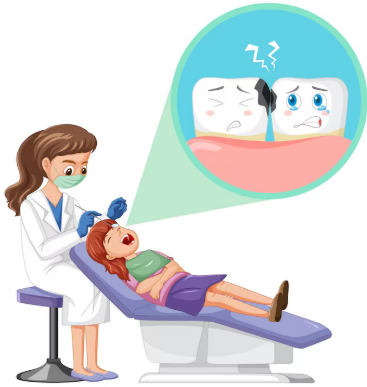
Most parents think of baby teeth as not important because they will fall out someday.. This is a big mistake. If you do not take care of baby teeth problems can happen quickly. The bone in a childs jaw is small so infection can spread fast. If you wait for a cavity to get better on its own or if you think a simple filling can fix an infection you are wrong. Your child will probably end up in the hospital. Might even lose a tooth too soon. When a cavity gets really bad and reaches the inside of a baby tooth the only way to save the tooth is, with help.
The Inner Anatomy of a Primary Cavity
A baby tooth is really different from an adult tooth. The hard outer layer of a baby tooth, which is called enamel is very thin. It is often than one millimeter thick. This means that even a small cavity on the surface of a baby tooth can quickly get to the layers of the baby tooth. This can happen in a few months because the enamel, on a baby tooth is so thin.
When bacteria get into the dentin they go into the pulp. The dental pulp is where the blood vessels and nerves are. If the infection only gets into the part of the crown a pediatric specialist will do a procedure called a pulpotomy. This is to remove the tissue. The pediatric specialist will leave the part of the root pulp alone. This kind of treatment helps keep the root of the tooth alive. It lets the tooth work, like it should until the new tooth is ready to come in. The tooth can still be used normally. The living root is very important. The pediatric specialist wants to save it. The tooth will be okay until the permanent tooth comes in.
Consider the distinct boundaries between standard treatments and nerve-level care.
| Clinical Approach | Target Area | Primary Objective |
| Standard Composite Filling | Outer enamel and dentin | Restores surface structure after mild decay |
| Clinical Pulpotomy | Coronal pulp chamber only | Saves a living tooth with early nerve exposure |
| Full Pulpectomy | Crown and entire root canal | Remediates a completely dead, necrotic tooth |
Many parents mistakenly ask for a standard filling when the nerve is already exposed and bleeding. Placing a filling over infected pulp traps the bacteria inside, creating a painful abscess within days. Choosing the correct intervention requires assessing the deep structural status of the nerve chamber rather than looking at the surface hole.
A surface cavity in a baby tooth can breach the inner nerve chamber four times faster than it would in an adult.
Catching the infection before it migrates into the roots is the entire purpose of this clinical boundary.
Red Flags That Demand Immediate Clinical Evaluation
Your child cannot always describe localized nerve pain accurately. They will often complain of a vague earache, a headache, or simply refuse to eat hard foods. You must look for specific physiological indicators that signal an endangered nerve chamber.
Spontaneous pain that wakes a child up in the middle of the night is the most definitive clinical indicator of pulp inflammation. When your child is lying flat, blood pressure increases inside the head, causing intense throbbing pressure within the tiny chamber of the tooth. If your child is crying from dental pain without any physical food being present, the decay has likely breached the nerve.
Consider Omar, a seven-year- patient at our facility. He started eating his evening meals on the left side of his mouth. His parents also noticed he would throw tantrums when given chilled yogurt. At first they thought he was just being sensitive.. Then we took some digital X-rays. * They showed that the lower molar was badly decayed. The decay had spread into the tooth. Omar needed a pulpotomy procedure away. This was to stop the infection from spreading and affecting his sleep and ability to eat. The goal was to save Omars tooth and help him feel better. His parents were worried about his eating habits and overall health. We had to act Omars case was an example of why regular dental check-ups are important. They can help catch problems, like this before they get worse.
Persistent sensitivity to hot or cold liquids that lasts for more than a few minutes after the drink is gone is another warning sign. Healthy teeth bounce back from temperature shifts almost instantly, but an inflamed nerve stays irritated for prolonged periods.
Behavioral food avoidance is rarely a psychological phase; it is almost always a physical defense mechanism against nerve pain.
Waiting for a visible pimple to appear on the gums means the infection has already exited the tooth.
Preserving the Blueprint of Your Child’s Jaw
Maintaining a primary molar in its natural position is critical for the long-term development of your child’s facial structure. When a tooth is extracted prematurely due to severe decay, the adjacent teeth naturally tilt and drift into the newly vacant space. This movement completely blocks the path for the underlying permanent adult tooth, causing severe impaction or crowding.
Undergoing a timely pulpotomy acts as a structural defense system. By maintaining the physical root structure inside the bone, the tooth continues to guide the jaw’s natural growth pattern. This interceptive step falls under the philosophy of vital pulp therapy, which values biological preservation over aggressive, premature extractions.
Families prioritizing premium healthcare understand that precision medicine is essential for everyday needs. Accessing integrated Medical & Dental Services in Dubai ensures your child’s oral health is evaluated with the same technological rigor as any systemic condition. A dedicated team will always choose to save a primary tooth rather than pull it to avoid future orthodontic complications.
A primary molar saved today prevents thousands of dirhams in complex orthodontic corrections a decade later.
The natural tooth remains the absolute best space maintainer nature ever engineered.
The Reality of the Clinical Protocol
Many parents experience severe anxiety when they hear their child needs a nerve-related treatment, assuming it mirrors a traumatic adult root canal. The actual clinical experience is remarkably fast, straightforward, and entirely painless when managed by experienced hands.
During a standard pulpotomy procedure, the clinician isolates the tooth and removes the decayed outer layers under local anesthesia. The infected pulp inside the upper crown chamber is carefully cleaned out, while the healthy pulp inside the root canals is left completely untouched. The chamber is then treated with a specialized therapeutic medication to soothe the remaining tissue and seal out future bacteria.
Because the treated primary tooth becomes slightly more brittle after the inner tissue is removed, it must be reinforced immediately. A high-quality stainless steel or tooth-colored ceramic crown is placed over the tooth during the same appointment to protect it from fracturing under chewing forces. For families living in the surrounding residential hubs, scheduling this at a premium Dental & Medical Center International City guarantees world-class clinical hospitality and efficient, single-visit care.
The entire nerve intervention takes less than fifteen minutes from the initial isolation to the final crown placement.
Demystifying the steps allows you to approach your child’s appointment with complete analytical confidence.
Frequently Asked Questions
Is a pulpotomy the exact same thing as an adult root canal?
No it is a less invasive procedure. A pulpotomy is designed for baby teeth. An adult root canal is different. It involves removing the nerve from both the crown and the entire root system of the tooth. A pulpotomy only removes the inflamed nerve tissue from the part of the tooth. This procedure keeps the root pulp alive and functional. This helps the baby tooth to shed later in life. The pulpotomy and root canal are two procedures. The pulpotomy is for teeth. The root canal is, for adults.
Why can’t the dentist just perform a standard filling instead?
A standard filling is only effective when decay is restricted to the outer enamel and dentin layers. If bacteria have already reached the living pulp chamber, placing a filling over the top traps the active infection inside the tooth. This leads to severe pain, a localized abscess, and eventual destruction of the underlying bone structure.
Will my child feel significant pain during or after the appointment?
Your child will be given anesthesia to numb the area before the procedure starts. This means they will only feel some pressure.The infected nerve tissue in the part is taken out. This gets rid of the source of their pain.Some tenderness around the gum area is normal after placing a crown. This can be easily handled with pain relievers, for kids that you can buy without a prescription. This usually lasts twenty-four hours.
What happens if we choose to ignore the signs and skip the pulpotomy?
If you do not pay attention to the warning signs the bacterial infection can spread past the tooth crown. Go down into the roots. It can even get into the jawbone around the tooth. This can lead to bad swelling in your face very high fevers and it can hurt the adult tooth that is still growing underneath. The tooth can become badly damaged that it dies. When this happens the tooth will have to be pulled out with surgery which’s a much more difficult and stressful process, for the tooth.
Can a permanent adult tooth ever require a pulpotomy?
The dentist can do this treatment on permanent teeth. These are teeth that have not finished growing. They can still grow if they get hurt or have decay. The goal is to keep the part of the tooth alive. This way the permanent tooth can keep growing its roots until they’re the right size. When the roots are all grown the dentist will treat the tooth, like any adult tooth if something else goes wrong with it.
Prioritizing your child’s long-term health requires moving past the outdated mindset that primary teeth are entirely disposable. By paying close attention to early indicators like nocturnal pain and sudden shifts in eating habits, you can intervene long before an extraction becomes mandatory.
Partnering with an integrated medical facility ensures your family receives seamless, data-driven care for every daily health need. Protect your child’s developmental path by choosing precise clinical preservation over reactive damage control.


