

Dental disease in children is largely silent until it is advanced. That single characteristic explains most of what parents find frustrating about it.
A cavity that presents as acute pain in September has usually been developing since March. The child gave no indication, ate normally, complained of nothing. By the point discomfort appears, the lesion has typically reached the dentine and the treatment required is considerably more involved than it would have been six months earlier.
Detection therefore depends on observation rather than on the child reporting symptoms. Most of the early indicators are visible to a parent who knows what to look for, and the majority of paediatric dental disease is preventable when those indicators are acted on. Effective children’s dental care in International City is largely a matter of knowing what to examine, and how often.
This guide sets out the conditions presenting most frequently in children’s dental care in International City, and what each one requires of a parent.
The assumption that causes the most damage
Primary teeth are temporary, therefore decay in them is of limited consequence.
This belief accounts for a substantial proportion of paediatric extractions, and it is mistaken on three separate grounds.
Primary molars maintain arch space. When one is lost prematurely, adjacent teeth migrate into the gap, and the permanent successor erupting several years later has insufficient room. The resulting crowding requires orthodontic correction that costs considerably more than the original restoration would have.
Infection does not observe the distinction between primary and permanent. An abscess at the root of a primary tooth sits immediately above the developing permanent tooth and can affect enamel formation before eruption.
There is also the matter of the child’s daily functioning. Persistent dental discomfort disrupts eating, sleep and concentration, and is rarely identified as the cause when a young child becomes withdrawn or irritable.
Demineralisation along the gingival margin
Examine the upper front teeth where they meet the gum. Dull, chalky white bands in that position are not surface staining. They represent early demineralisation, the initial stage of decay before cavitation occurs.
This stage is reversible. Fluoride application combined with a change in feeding habits can arrest and partially reverse it. Left for a further six months, it progresses to a cavity requiring restoration under conditions a young child will find considerably more difficult.
The usual cause is prolonged bottle or sippy cup use, particularly overnight and particularly with milk, juice or any sweetened liquid. Salivary flow reduces during sleep, and the liquid remains in contact with the upper anterior teeth for hours. Water at night resolves it, and in most cases resolves it completely. Few measures in children’s dental care in International City return as much for as little.
Frequency of sugar exposure, not quantity
Parents commonly restrict sweets and remain puzzled by recurrent decay. The reason is that the relevant variable is exposure frequency rather than total volume.
Each intake of sugar lowers oral pH for approximately twenty to forty minutes while saliva restores neutrality. Confectionery consumed in a single sitting constitutes one acid challenge. The same quantity consumed intermittently across an afternoon constitutes six or seven.
In practical terms, juice consumed slowly over an hour, sweetened laban, dried dates kept in a school bag and flavoured milk before bed present greater risk than dessert taken with a meal. Sound dental care for children depends more on confining sugar to mealtimes than on eliminating it, which is also a considerably more sustainable instruction for a family to follow.
Persistent digit sucking beyond age three
Entirely normal in infancy. It warrants attention after the age of three and active intervention if it persists beyond four or five.
Sustained pressure influences maxillary development. The consequences include anterior open bite, a narrowed palatal arch and proclination of the upper incisors. Where the habit ceases early, a degree of self-correction generally follows. Where it continues into the mixed dentition stage, it usually does not, and orthodontic treatment becomes necessary.
Punitive approaches tend to reinforce the behaviour, since it functions as self-soothing and increases under stress. A kids dentist who has managed the problem regularly will normally propose a graduated approach based on positive reinforcement, and will often address the child directly rather than through the parent.
Mouth breathing, snoring and disturbed sleep
This is frequently overlooked, because parents do not categorise it as a dental matter.
A child who habitually breathes through the mouth, snores, or wakes unrefreshed may have enlarged adenoids or tonsils, or untreated allergic rhinitis. Given prevailing conditions in Dubai — air conditioning, ambient dust and seasonal variation — allergic rhinitis is common in children here and frequently goes unmanaged.
The dental implications are significant. Chronic mouth breathing alters facial and jaw development over a period of years, contributes to crowding, and produces oral dryness that accelerates caries. Sleep quality is affected as well, and the resulting concentration and behavioural difficulties are usually attributed to other causes.
Cases of this kind illustrate the value of a provider offering combined Medical & Dental Services in Dubai, since the dental finding and its medical origin require assessment together rather than through separate referrals months apart.
Nocturnal grinding
Generally audible, and most parents become aware of it without prompting. It occurs commonly between the ages of three and six and is frequently outgrown.
Raise it with your kids dentist at the next scheduled appointment rather than treating it as urgent. It becomes clinically significant where the teeth show visible wear, where the child reports morning jaw discomfort or headache, or where the habit begins abruptly during a period of stress.
Permanent teeth erupting lingual to the primary teeth
At approximately six or seven years, a second row of teeth appears behind the lower primary incisors while those teeth remain in place.
Few presentations prompt more enquiries in children’s dental care in International City, and the appearance concerns parents more than the condition warrants. In most cases it resolves once the primary teeth loosen and exfoliate naturally, and encouraging the child to move them is sufficient. Where the primary tooth remains firm after several weeks and the permanent tooth continues to erupt behind it, extraction is indicated so that the successor can move into correct position.
Fissure depth in newly erupted molars
The first permanent molars erupt at around six years, at the posterior of the arch, and frequently without parents registering their arrival.
Their occlusal surfaces contain deep fissures that toothbrush bristles cannot access. A high proportion of caries in older children develops in precisely these sites, undetected until the lesion is extensive. Fissure sealants, a protective resin coating applied over the grooves, require a few minutes, no anaesthetic and no drilling, and prevent a substantial share of that disease. They remain under-used, and represent one of the most cost-effective interventions available in pediatric dentistry.
Dental trauma: the first ten minutes
Worth reading in advance of needing it.
Avulsed permanent tooth. Handle the crown only, never the root. Rinse briefly in milk or saline if contaminated, without scrubbing the root surface. Where possible, reposition it in the socket and have the child hold it in place with a clean cloth. If reimplantation is not possible, transport it in milk — not water and not dry — and attend a dentist within the hour. Elapsed time is the primary determinant of outcome.
Avulsed primary tooth. Do not attempt reimplantation, which risks damaging the developing permanent tooth beneath. Assessment is still required, though the urgency differs.
Fractured tooth. Bring any recovered fragment in milk. Same-day assessment is advisable, as a fracture involving or approaching the pulp requires different management from a superficial one.
Facial or intraoral swelling, particularly with fever. This should not be deferred to the following morning. Odontogenic infections spread, and in children they spread rapidly.
Recommended schedule
Children’s dental care in International City should begin earlier than most parents anticipate. A first appointment is advised by the first birthday, or within six months of the first tooth erupting, largely so that the child establishes familiarity with the environment before any treatment is required.
Brushing should commence with the first tooth: a smear of fluoride toothpaste below the age of three and a pea-sized quantity from three to six. Children do not develop sufficient manual dexterity to brush effectively until approximately seven or eight, so an adult should perform or complete the procedure until then.
Examinations every six months. Sealants applied to permanent molars following eruption. Orthodontic assessment at around seven years, which is early enough to guide jaw development rather than only to correct it subsequently.
About Medlite
Our dental department has served families across International City, Dragon Mart and Warsan for over five years. A considerable proportion of our paediatric appointments present in the manner described at the beginning of this article: acute pain, out of hours, with no prior indication that anything was wrong.
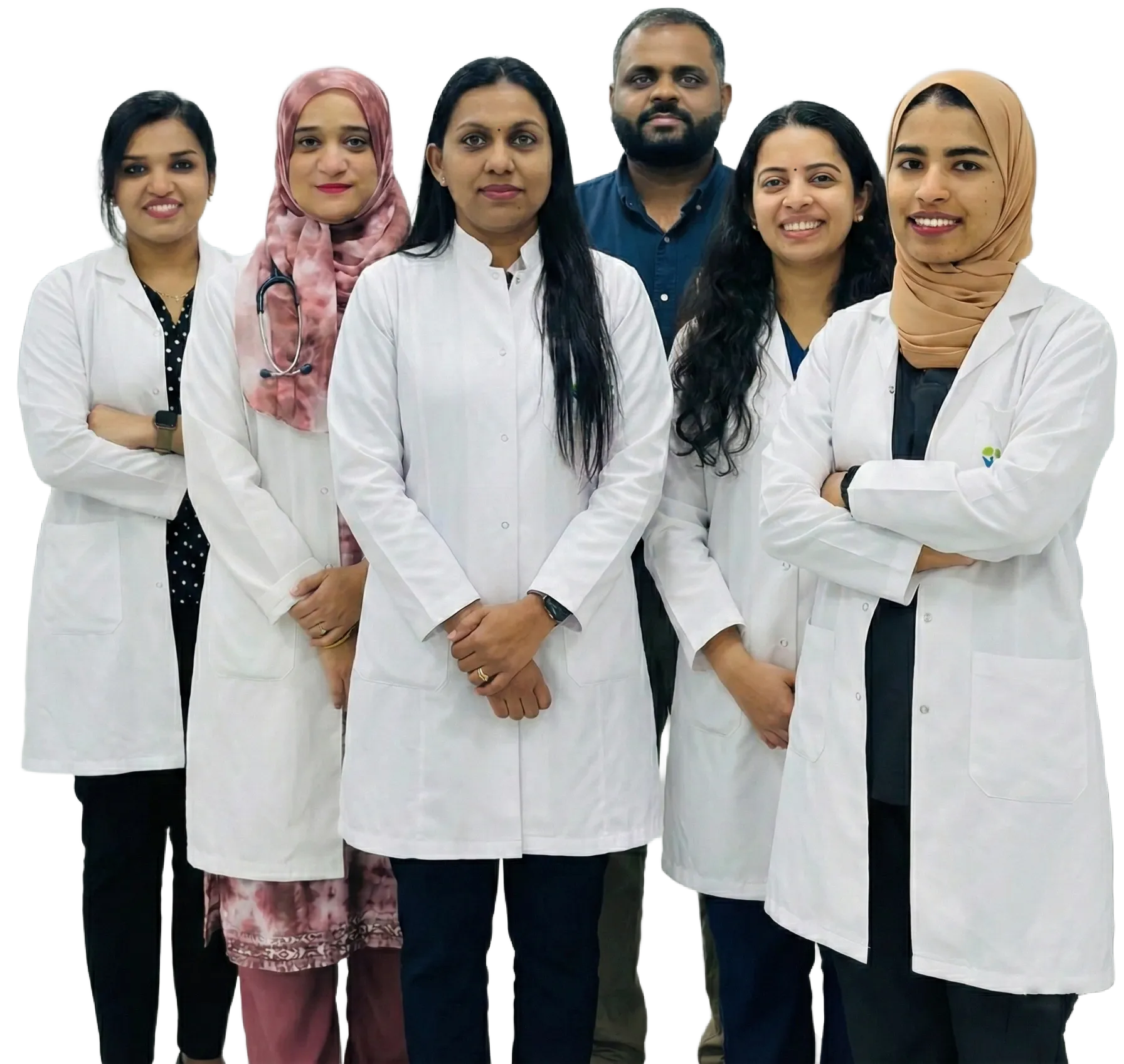
Dr. Asha Nair and Dr. Inshad Iqbal cover pediatric dentistry alongside general and cosmetic work, managing first examinations, sealants, restorations, extractions and orthodontic assessment. Anxious children are expected rather than exceptional, and an initial appointment frequently consists of nothing beyond sitting in the chair and having the teeth counted. That first uneventful visit contributes more to a child’s long-term attitude toward treatment than anything that follows it.
Because our general medicine department, laboratory and pharmacy operate from the same premises, presentations such as persistent mouth breathing or recurrent infection can be investigated properly rather than referred elsewhere.
For parents assessing options for children’s dental care in International City, or seeking a Pediatric Dentist in International City Dubai, we are located at Shop No. 5 & 6, Riviera Dreams Building, CBD-20. Consultations start at AED 60, and the centre is open daily from 8:00am to 9:00pm.